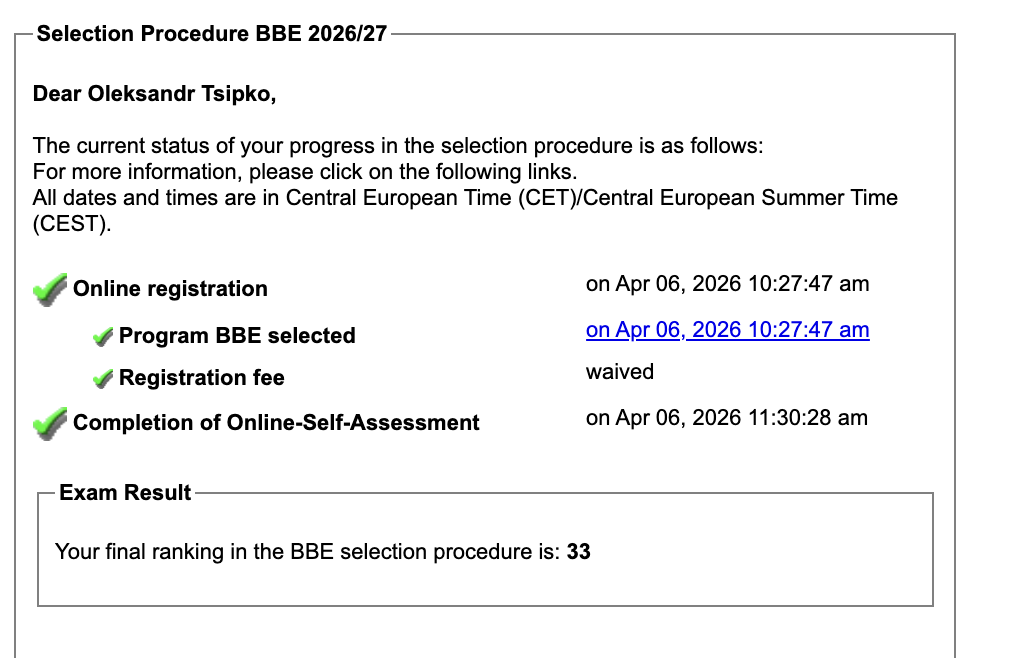
3,900 applicants for 240 spots — fewer than 7% will get in. Most will prepare casually and lose ground to those who know the format from the inside. A course by someone who scored 93.4% on this exact exam. Exam — June 30 2026.
A quick walkthrough of our online prep platform and how we prepare you for the BBE exam.
Mathematics is the most critical and challenging section. 3,900 applicants. 240 spots. Those who practised under timed conditions made it — those who did not, did not.
Time is the main enemy. Exam shortened from 2 hours 30 minutes to 2 hours. Math takes the most time. Without timed practice you'll fail not from lack of knowledge, but slowness.
Physical calculator allowed. The exam is not online, so a physical calculator is allowed. Importantly, check the official WU website for allowed models.
Partial scoring exists. Each question is a set of statements (True/False). You can earn partial points even if not all statements are correct.
Weight and Complexity. Maths and economics have the same part of the overall score, but maths is significantly more complex and requires more preparation.
Logic tasks are part of maths. This includes sequences and analytical thinking. Don't underestimate them — they require specific speed training to solve within the time limit.
Based on the official WU textbook: Fuhrmann B. (2019) 'Introduction to Business and Economics', chapters 1–6. This is the only official source. Questions test conceptual understanding — not just memorization.
One book — the only official source. Fuhrmann (2019) is it. WU publishes nothing else. Read chapters 1–6 carefully, not diagonally.
Focus on analysis, not rote learning. The exam tests the ability to apply theory to real business cases. Mechanical memorization will not yield results — it is important to understand the essence of economic processes.
The entire exam is in English — so even if your math is strong, weak English will ruin your result. Questions cover grammar, vocabulary, and reading comprehension on business, economics, and contemporary social issues.
B2+ level needed. WU requires B2 for admission, but a practical C1 level is an advantage for succeeding in the exam.
Read business media. Financial Times, The Economist, BBC Business — regular reading boosts both vocabulary and reading speed.
Context over rule knowledge. Grammar questions often require understanding meaning in context — not just memorized rules.
BBE is a procedure with strict deadlines. A missed step means exclusion, regardless of your academic potential.
I sat the BBE entrance exam myself and know it from the inside — which problems appear, where students lose time, which economics concepts are actually tested. My course is built not on guesswork, but on personal experience of passing this exact selection.
Practice is the only way to prepare. All tasks in True, False format, with explanations for every answer. No filler tasks — only what's actually tested.
Full exam simulation: same question format, same time pressure, same three sections. Mock exam replicates the exact BBE format — no surprises on exam day.
Not just materials — live task walkthroughs where I explain solution logic, typical mistakes, and exam strategy. You can ask questions in real time.
If within the first week you decide the course isn't right for you — full refund, no questions asked. This is how I demonstrate confidence in the quality of what I've built.
All packages include access to the online platform and materials until 30.06.2026
Over 3,000 applicants. Only 240 get in. The difference is the quality of preparation. Message me on Telegram — I'll tell you where to start based on your situation.